
Vertigo is one of those symptoms that can completely derail daily life — and one of the most frustrating to navigate when answers are hard to find. The spinning, the nausea, the feeling of being off-balance even while sitting still — it is disorienting in every sense of the word.
Many people with chronic or recurrent vertigo have already seen an ear specialist (ENT), a neurologist, and their primary care physician. They may have been diagnosed with BPPV, vestibular neuritis, or Meniere's disease — or they may have been told simply that their dizziness is 'idiopathic,' meaning no clear cause has been found.
What is rarely mentioned in these evaluations is the cervical spine. The upper cervical region — the top two vertebrae in the neck — plays a significant role in the human balance system, and dysfunction there can produce vertigo that is neurologically indistinguishable from inner-ear-driven vertigo. This article explains what vertigo actually is, what causes it, why the spine is so frequently overlooked, and what comprehensive evaluation and care looks like.
What Vertigo Actually Feels Like — and Why It's Different From Dizziness
Dizziness is a broad term that covers several distinct experiences: lightheadedness, a floating sensation, a feeling of being off-balance, or general unsteadiness. Vertigo is more specific. It refers to the distinct false sense that either you or the environment around you is spinning or moving when there is no actual movement occurring.
Vertigo episodes can last anywhere from seconds (as in BPPV, the most common form) to days (as in vestibular neuritis). They are frequently accompanied by nausea, vomiting, nystagmus (involuntary eye movement), and difficulty walking in a straight line. For some people, episodes are intense but brief; for others, a low-grade sense of imbalance persists between more acute episodes.
Because vertigo has multiple possible origins — the inner ear, the brainstem, the brain itself, or the cervical spine — accurate identification of the source is essential for choosing the right approach. Treating BPPV with vestibular rehabilitation will not resolve cervicogenic vertigo, and vice versa.
Vertigo is a false sense of movement driven by a mismatch in the balance-processing systems. Accurately identifying the origin — inner ear, brainstem, or cervical spine — is essential for choosing the right approach.
The Most Common Causes of Vertigo
BPPV — Benign Paroxysmal Positional Vertigo. BPPV is the most common form of vertigo, accounting for roughly half of all cases. It occurs when calcium carbonate crystals (otoconia) dislodge from the utricle of the inner ear and migrate into one of the semicircular canals. The result is brief, intense spinning that is triggered by specific head movements — rolling over in bed, looking up, or bending forward. The Epley maneuver, a series of guided head repositioning movements performed by a clinician, resolves BPPV in a large majority of cases.
Vestibular Neuritis and Labyrinthitis. Vestibular neuritis is inflammation of the vestibular nerve, typically following a viral illness. It produces sudden, severe vertigo that can last days and resolves gradually over weeks as the brain compensates. Labyrinthitis involves both the vestibular nerve and the hearing pathways, causing associated hearing changes alongside vertigo. Vestibular rehabilitation therapy — a specialized form of physical therapy — is the most evidence-supported long-term treatment for both conditions.
Meniere's Disease. Meniere's disease results from abnormal fluid pressure in the inner ear (endolymphatic hydrops). It produces episodic vertigo lasting 20 minutes to several hours, alongside fluctuating hearing loss, tinnitus, and a sense of fullness in the affected ear. Low-sodium diet and diuretics are commonly recommended first-line approaches. For cases that do not respond to conservative management, more involved medical interventions may be considered.
BPPV, vestibular neuritis, and Meniere's disease are distinct conditions with different drivers and different treatments. An accurate diagnosis is the foundation of effective care.
Why the Cervical Spine Is So Often Missed
The upper cervical spine — specifically the atlas (C1) and axis (C2) — is surrounded by a remarkably dense network of proprioceptors: specialized sensory receptors that send continuous positional information to the brainstem. The brainstem uses this input alongside data from the inner ear and the visual system to construct an accurate picture of where the body is in space.
When the atlas is misaligned, the proprioceptive signals it generates become distorted. The brainstem receives conflicting information — accurate signals from the inner ear, inaccurate signals from the cervical spine — and interprets this conflict as movement. The result is vertigo that is neurologically identical to inner-ear-driven vertigo, even though the source is structural.
This mechanism, called cervicogenic dizziness or cervicogenic vertigo, is underdiagnosed for a straightforward reason: standard vestibular testing does not evaluate the cervical spine. Electronystagmography, rotational chair testing, and posturography all assess inner ear function — none of them look at C1 or C2 position. A patient can pass every vestibular test and still have significant, addressable cervicogenic vertigo.
Key signs that the cervical spine may be contributing include: vertigo that began after a car accident, fall, or neck injury; episodes that are triggered or worsened by turning the head or sustaining certain neck positions; accompanying neck pain or stiffness; and a history of whiplash even years in the past, since atlas displacement can persist until it is specifically corrected.
Standard vestibular testing does not evaluate the cervical spine. A patient can pass every ENT and neurology test and still have significant cervicogenic vertigo.
How Upper Cervical NUCCA Care Addresses Vertigo
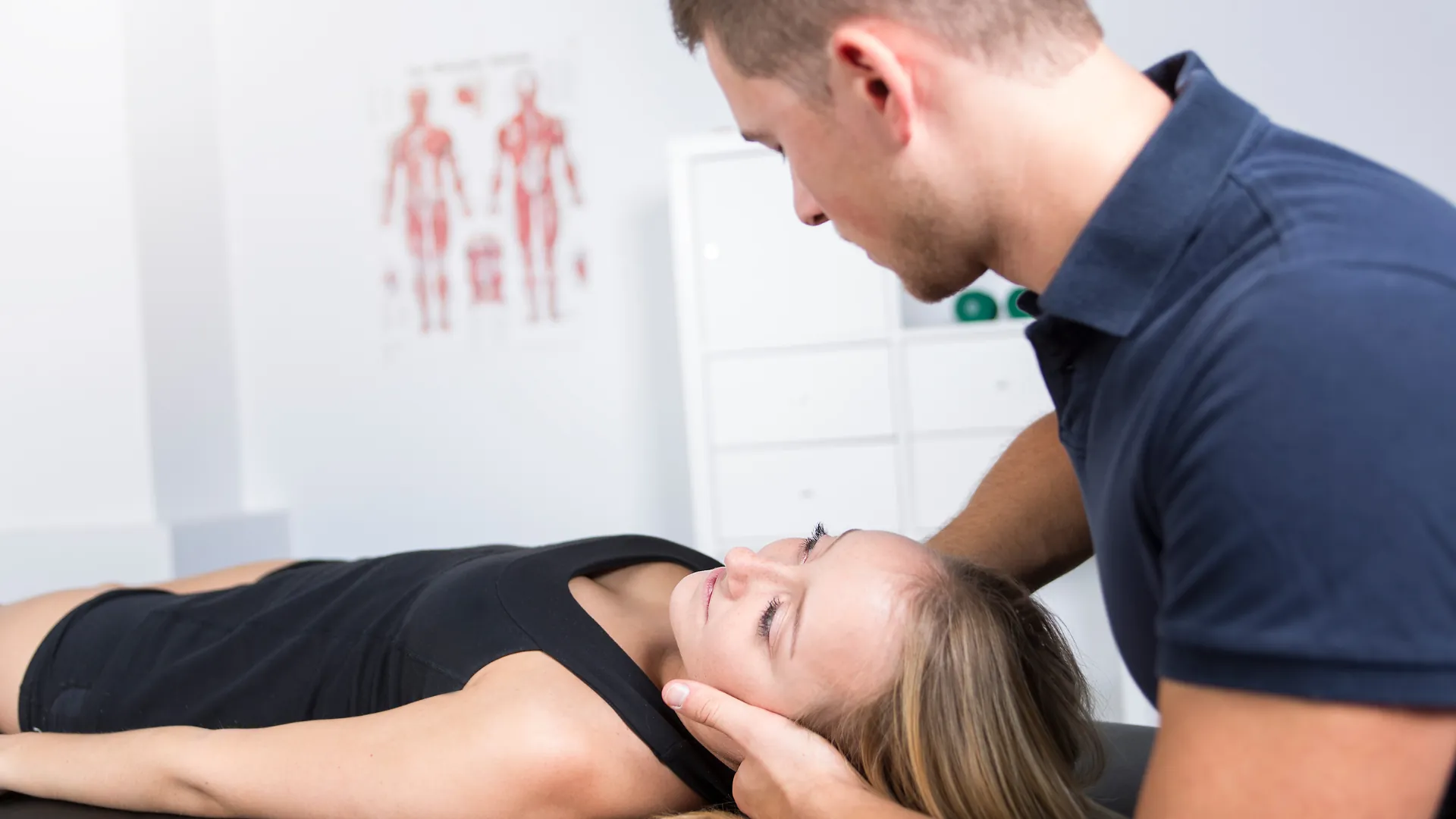
Upper cervical NUCCA chiropractic care focuses specifically on identifying and correcting misalignment at C1 and C2. Unlike general chiropractic, NUCCA does not involve rotational neck cracking or high-velocity thrusting. Corrections are delivered with a gentle, sustained contact at the base of the skull — most patients describe feeling very little during the adjustment itself.
The assessment process begins with advanced imaging — digital X-ray or CBCT — that measures the three-dimensional position of the atlas. This reveals the specific direction and degree of any displacement, allowing the correction to be precisely tailored to each patient rather than applied as a generalized protocol.
For patients whose vertigo has a cervicogenic component, atlas correction often produces noticeable changes in symptom frequency and intensity within the first several corrections. For patients where cervicogenic vertigo coexists with inner ear pathology, NUCCA care and vestibular rehabilitation used together tend to produce better outcomes than either approach alone.
For BPPV specifically, some NUCCA practitioners also incorporate canalith repositioning maneuvers (Epley technique) into their care — a clinically well-supported intervention that resolves BPPV in a high percentage of cases regardless of provider type when performed correctly.
What Standard Medical Care Offers
Medical management of vertigo is genuinely effective when the condition is accurately identified. BPPV responds remarkably well to canalith repositioning maneuvers. Vestibular rehabilitation — a specialized form of physical therapy that retrains the brain's compensation mechanisms — is one of the most evidence-supported long-term interventions for persistent vertigo of most types. Vestibular suppressant medications can help reduce acute symptom severity, but long-term use is generally avoided because it can slow neurological compensation.
Surgical options exist for severe Meniere's disease that has not responded to conservative management, though they are reserved for cases where other approaches have been exhausted. If vertigo has a significant anxiety component — which is common, as vertigo itself can be frightening — cognitive behavioral therapy has shown clinical benefit alongside vestibular rehabilitation.
Summary
- Vertigo has multiple distinct causes — BPPV, vestibular neuritis, Meniere's disease, and upper cervical misalignment — each requiring a different approach.
- The upper cervical spine contributes to balance by sending continuous proprioceptive signals to the brainstem; misalignment at C1/C2 distorts those signals and produces genuine vertigo.
- Cervicogenic vertigo is systematically missed because standard vestibular testing does not evaluate the spine — key signs include post-injury onset, position-dependent episodes, and accompanying neck pain.
- NUCCA upper cervical care restores accurate proprioceptive signaling with gentle, low-force corrections; combined with vestibular rehabilitation when needed, it addresses both structural and neurological components.