
What is sciatica and why does it keep coming back?
Sciatica refers to compression or irritation of the sciatic nerve — the longest nerve in the body, running from the lower lumbar spine through the buttock and down each leg to the foot. Common symptoms include sharp, burning, or shooting pain along this pathway, numbness or tingling in the leg or foot, and muscle weakness that can make standing or walking difficult.
The most common structural contributors include lumbar disc herniation, spinal stenosis, piriformis syndrome, and sacroiliac joint dysfunction. What these often have in common is that they are influenced by how body weight distributes through the lumbar spine and pelvis — and that loading pattern is often set from the top of the spine, not the bottom.
A few things worth knowing about sciatica:
- About 40% of people will experience sciatica at some point in their lives
- The vast majority of sciatica cases improve without surgery when the structural factors are identified and addressed

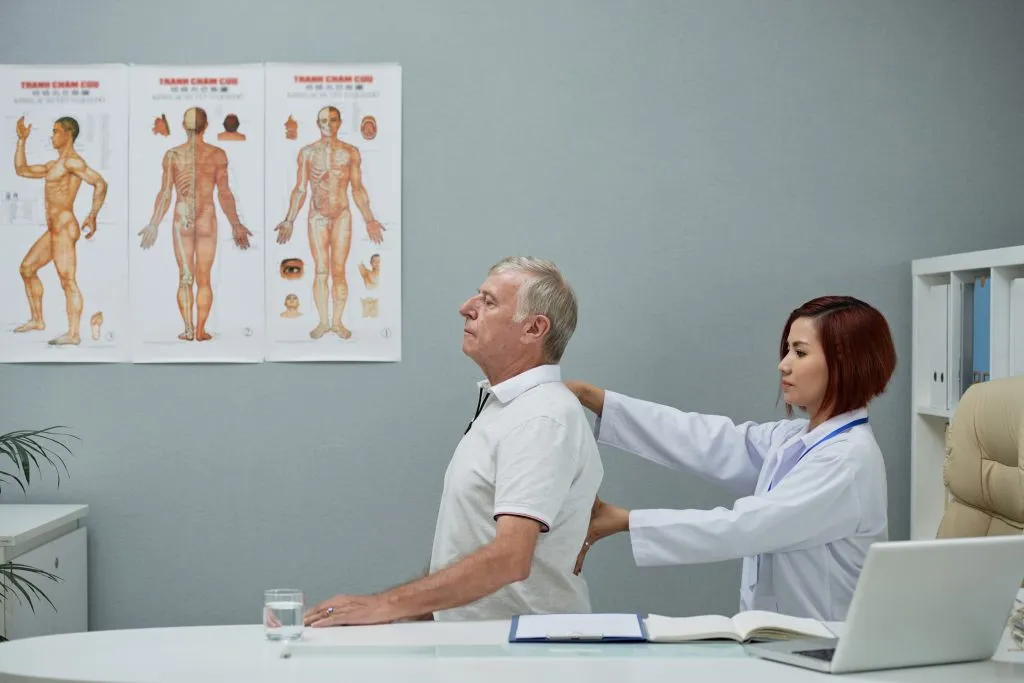
The upper cervical connection to lower back and sciatic pain
The spine functions as a single integrated unit. When the atlas (C1) is misaligned at the top of the spine, the body compensates by shifting posture throughout the entire column — the head tilts, one shoulder drops, the pelvis rotates and tilts to one side, and one leg functionally shortens. This postural pattern is measurable: it often appears as visible leg length inequality, uneven shoulder height, and altered pelvis position.
This whole-body postural shift concentrates compressive and shear forces on the lumbosacral junction and the intervertebral discs — the precise levels where disc herniation and sciatic nerve compression most commonly occur. By addressing atlas alignment and restoring more balanced posture from the top down, NUCCA may reduce this loading and help address a primary driver of recurring sciatica.
Why treating only the lower back sometimes falls short
Physical therapy, epidural steroid injections, and lower back manipulation can all provide meaningful relief — and we support patients pursuing those options. But if the postural imbalance from an uncorrected atlas shift remains, the lumbar spine will continue to receive asymmetric loading every day. This may be why some people find that treatments which initially helped eventually stop working, or why sciatica keeps returning.
NUCCA doesn’t replace these treatments. It looks for the postural driver that may make other treatments more effective and longer-lasting. Many patients at Johnson Spinal Care report meaningful improvement in lower back and leg symptoms after atlas correction — changes they had not achieved from lumbar-focused care alone.
How NUCCA addresses sciatica — step by step
Full postural assessment
We evaluate leg length, pelvic tilt, shoulder height, and head position to understand the postural pattern.
Advanced upper cervical imaging
3D atlas displacement measurement to determine the direction and degree of any misalignment.
NUCCA correction
Gentle, precise atlas adjustment that begins restoring postural balance from the top of the spine down.
Immediate postural re-measurement
Most patients show measurable changes in leg length and posture shortly after the first correction.
Lumbar reassessment
As the upper cervical correction is maintained over time, loading on the lumbar spine may normalize and sciatica-related factors progressively improve.
Collaborative care when helpful
We work alongside your spine specialist, physical therapist, or other providers as appropriate.

Sciatica symptoms NUCCA may help support
| Sciatica Symptom | How Upper Cervical Correction May Help |
|---|---|
| Radiating pain from back to leg | Reduces postural load on the lumbar spine and compressed sciatic nerve roots |
| Numbness or tingling in leg or foot | May help decompress the nerve root indirectly through postural normalization |
| One-sided hip or buttock pain | May correct pelvic tilt and sacroiliac stress from atlas-driven imbalance |
| Pain worse when sitting or driving | Sustained flexion load worsens with postural imbalance — correction may reduce the baseline load |
| Recurring sciatica despite prior treatment | May address the postural driver that previous treatments were not looking for |
| Sciatica following whiplash or injury | Whiplash can displace the atlas, triggering a full postural cascade — NUCCA directly addresses the structural injury source |
Serving sciatica patients in Savage, Apple Valley & White Bear Lake
Our Savage location is particularly convenient for sciatica patients in the south metro — including Savage, Prior Lake, Shakopee, Burnsville, Farmington, and Lakeville. If you have been searching for a sciatica chiropractor in or near Savage MN, our clinic is minutes away and ready to provide a comprehensive upper cervical evaluation.
Apple Valley and White Bear Lake locations serve the broader metro, including Eagan, Rosemount, Maplewood, and Woodbury. All three clinics offer the same NUCCA-certified care and the same commitment to understanding the structural source of your sciatica.
Frequently asked questions
NUCCA upper cervical chiropractic looks for the full-body postural imbalance — driven by atlas misalignment — that may be concentrating excessive load on the lumbar spine and sciatic nerve. Johnson Spinal Care has worked with sciatica patients across Minnesota since 1986 from three Twin Cities locations: Savage, Apple Valley, and White Bear Lake.
Johnson Spinal Care’s Savage clinic serves sciatica patients throughout the south metro Twin Cities area. Our NUCCA-trained doctors use gentle, imaging-guided upper cervical corrections to look for and address the postural loading pattern that may be driving sciatic nerve compression. Call (952) 432-3333 or book online at johnsonspinalcare.com.
NUCCA corrections do not involve the lumbar spine directly — there is no manipulation of the lower back. The atlas adjustment is a gentle, low-force contact at the base of the skull that can produce systemic postural changes. This makes NUCCA a comfortable option even for patients with significant lumbar disc herniation or stenosis who cannot tolerate direct lower back manipulation.
Postural changes — including measurable leg length equalization and pelvic rebalancing — are often visible shortly after the first NUCCA correction. Reduction in sciatic pain and radiating symptoms may develop gradually over 4–8 weeks as the corrected posture reduces loading on the affected nerve structures. Patients with long-standing sciatica may benefit from a longer stabilization period.
Most sciatica cases improve without surgery when the contributing structural factors are identified and addressed. A NUCCA upper cervical evaluation is a non-invasive first step — it identifies whether postural imbalance from atlas misalignment may be a contributing factor, and corrections carry no side effects or recovery period. If conservative care does not provide adequate relief after a reasonable trial, surgical consultation is appropriate. We can help coordinate that process.

Ready to learn more about your sciatica?
If you have been living with sciatica and are looking for a different kind of approach — one focused on finding the underlying cause — Johnson Spinal Care may be a good fit. Our NUCCA-trained doctors have served Minnesota patients for 35 years from three convenient Twin Cities locations.