
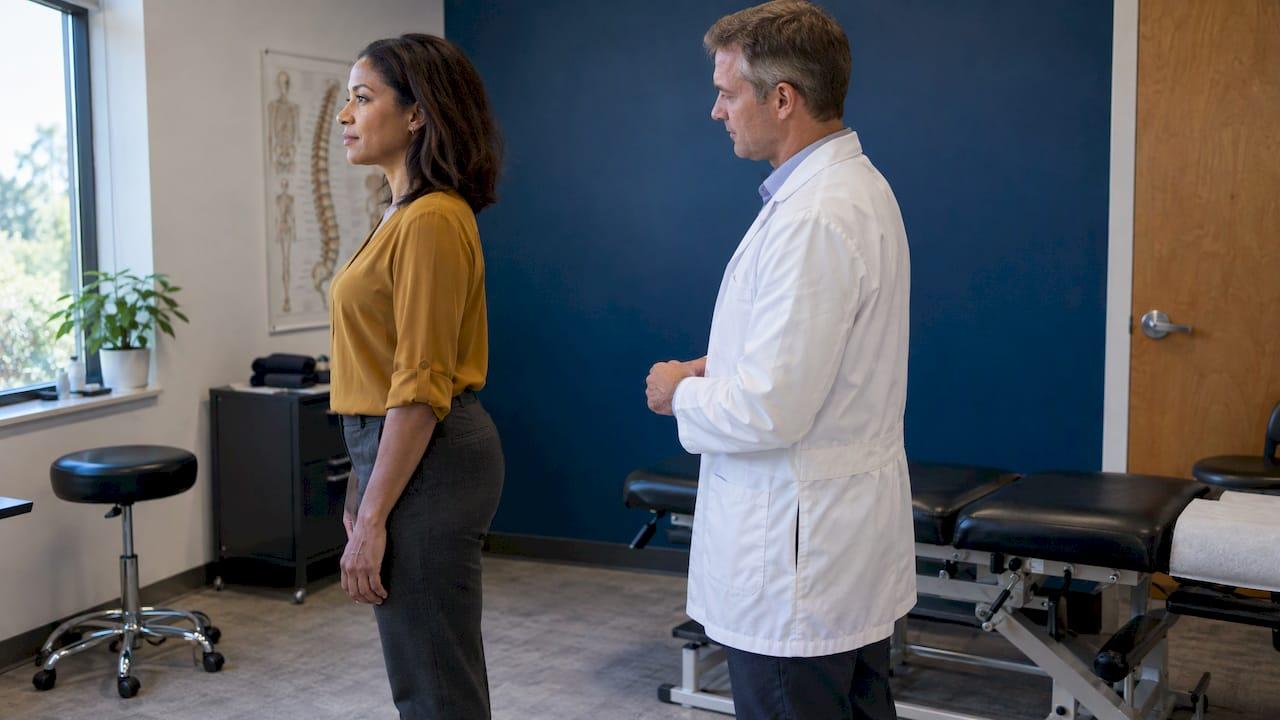
Chiropractic care can be a useful part of improving posture, especially when the upper neck and forward head position are involved. It works best when joint function, muscle balance and daily habits are all addressed together. A chiropractor will not “fix” posture in one visit. A good plan starts with careful measurement, uses a gentle correction, and gives you simple exercises and workstation changes that keep the progress going.
At Johnson Spinal Care, we have focused on the upper cervical spine since 1986, when Dr. Kerry and Lisa Johnson opened the first NUCCA chiropractic clinic in Minnesota. Below, we explain what the research says, what a posture exam involves, how long change takes and what you can do at home starting today.
TL;DR
- A 2022 review of 14 studies found that manual therapy reduced forward head posture in the short and medium term, with moderate certainty.
- A posture exam should include measurement from the side, front and back, not just a quick look.
- Expect weeks for early change and a few months for lasting change. Daily habits matter as much as visits.
- Our NUCCA approach measures and images the upper neck first, then uses a low-force correction with no twisting or cracking.
- Pair care with screen height changes and short exercise breaks every 20 to 30 minutes.
Table of Contents
- Can a chiropractor help with posture?
- Why the upper neck matters for head position
- What a chiropractic posture analysis involves
- What a NUCCA adjustment feels like
- What the research says about forward head posture and structural care
- How long does it take to improve posture?
- What you can do between visits
- Posture after a car accident or injury
- Posture for children, athletes and older adults
- What does chiropractic posture care cost?
- Our perspective: posture starts at the top
- See a NUCCA doctor about your posture
- FAQ
- Sources
Can a chiropractor help with posture?
Yes, as part of a broader plan. Posture is the result of how your joints move, how your muscles share the load and how you spend your hours. Chiropractic care addresses the joint side and, in many offices, the education side.
The best summary evidence comes from a 2022 systematic review and meta-analysis of manual therapy and body posture. Across 14 studies and 584 people, manual therapy reduced forward head posture compared with no treatment or sham treatment in the short and medium term, and the authors rated their certainty as moderate. It also reduced thoracic kyphosis (the rounding of the upper back) and improved pelvic tilt measures.
The same review is a useful reality check. Manual therapy showed no significant effect on shoulder protrusion, shoulder alignment or pelvic anteversion. Posture has many parts, and some respond more readily than others. That is why a thorough exam matters: it shows which parts of your posture are actually driving your symptoms.

Why the upper neck matters for head position
Your head weighs roughly as much as a bowling ball, and it sits on the atlas (C1) and axis (C2), the two highest vertebrae. When the head drifts forward of the shoulders, the muscles at the back of the neck and the base of the skull work harder to hold it up. Over months, that can show up as stiffness, tension headaches, shoulder tightness and a head that sits ahead of your body even when you try to stand tall.
The upper neck is also one of the most mobile regions of the spine and is rich in the sensors that tell your brain where your head is in space. That is why we look there first. Our doctors are trained in NUCCA, a technique that evaluates and corrects the relationship between the atlas and the skull in a very precise, measured way.
We do not claim that one adjustment straightens a lifetime of slouching. Our approach is designed to restore balance at the top of the spine so the rest of your body has a better foundation to hold good posture, and so that your exercises and ergonomic changes work with you instead of against you.

What a chiropractic posture analysis involves
A proper posture analysis is more than standing against a wall. In a 2026 narrative review on upper crossed syndrome in the workplace, the authors describe static postural assessment using a plumb line and grid chart, usually viewed from behind, from each side and from the front. The side views are the most important for spotting forward head posture and rounded shoulders.
At our clinics, a first visit includes these elements:
- Your history. Where you hurt, when it started, any accidents or sports injuries, and what you have already tried.
- Visual and hands-on posture assessment. How your head, shoulders and hips line up, and how your neck and upper back move.
- Advanced imaging and measurement. Before any adjustment, we take precise measurements of the upper cervical spine so the correction is based on your anatomy, not a guess.
- A plan. If NUCCA care is a good fit, we explain what we found, what we recommend and how often we expect to see you.
If your history suggests something that needs a medical doctor first, such as severe or sudden symptoms, numbness or weakness, we will tell you and coordinate with your medical team.
What a NUCCA adjustment feels like
Many people who search for posture help are wary of having their neck twisted or cracked. A NUCCA correction does not involve either. Once measurements show how the atlas sits, the doctor applies a light, specific correction in a calculated direction. Most patients describe it as gentle, and many feel little beyond a sense of warmth or relaxation. You can read more about how low-force chiropractic care works and what to expect in the room.
The goal is a correction that holds. We re-measure over time, and the plan is aimed at holding alignment so that, as things settle, you need fewer visits.
What the research says about forward head posture and structural care
Several studies have looked at structured programs that combine corrective procedures with exercise. They are a different technique from NUCCA, but they show that forward head position can respond to organized care.
- A 2023 randomized controlled study of 66 older adults with forward head posture compared a structural program (mirror image exercise plus a cervical traction orthotic) with standard exercise. After 6 weeks, only the structural group showed a significant improvement in craniovertebral angle, and at 3 months it kept its advantage while the standard group slipped back.
- The same study noted that average angles remained near the normal threshold, so many people would need continued care, and the follow-up was short. In plain terms: improvement is real, and it takes consistency.
- A 2022 review of case reports found an average 12 mm reduction in forward head position after 40 treatments over 16 weeks, with lower pain ratings.
What these studies share is the pattern we build into our own plans: a structural component, active exercise and follow-up measurement. Posture improves when someone does something about the joints and the muscles, and keeps doing it.
How long does it take to improve posture?
Weeks for the first change, months for the lasting change. The Cleveland Clinic puts real change in posture habits at about four to six weeks. A physical therapist’s 2026 timeline describes noticeable improvement within 2 to 6 weeks of consistent stretching, strengthening and awareness, with more significant changes over 2 to 6 months as the nervous system learns the new pattern.
A few things speed up or slow down the process:
| Factor | Helps | Slows |
|---|---|---|
| Consistency | Short exercises many times a day | One long session a week |
| Work setup | Screens at eye level, standing breaks | Hours of laptop use on a low desk |
| How long it has been there | Recent pattern | Years of the same position |
| Other issues | Good sleep, managed stress | Old injuries, poor sleep |
| Care plan | Exam, measurement and a clear plan | Guessing |
If you have had the pattern for years, you can still change it. Harvard Health notes it is usually not too late to improve posture, because while bones cannot be changed, muscles can be strengthened and lengthened, especially in the upper back, chest and core.
What you can do between visits
The same 2026 review recommends practical workstation changes. Here is how we turn them into a daily routine:
- Raise every screen to eye level. Use a stand or a stack of books for a laptop, and add a separate keyboard.
- Bend your elbows to about 90 degrees with your wrists straight and relaxed.
- Change positions through the day, especially if you use more than one screen.
- Stand up every hour.
- Do a short set of exercises at your desk every 20 to 30 minutes rather than one workout at the end of the day. The review’s author recommends this spacing, and a Cochrane analysis cited in the research points the same way: frequent short sessions beat occasional long ones.
- Practice a chin tuck. Draw your head straight back, as if making a gentle double chin, hold for a few seconds and release. Repeat a few times. Stop if it causes pain, dizziness or tingling in your arms, and tell your doctor.
- Open your chest and strengthen your upper back. Doorway chest stretches and rows with light resistance are common choices. We will show you the version that suits you.
If you wake up with a stiff neck, your pillow and sleep position may be part of the picture. Our guide to waking up with neck pain covers it. If your neck bothers you on the commute, see our article on neck pain when driving.
Posture after a car accident or injury
After whiplash, people often guard their neck and hold their head forward without noticing. The University of Queensland’s RECOVER Injury Research Centre recommends postural advice and exercises in the sub-acute stage, between 2 and 12 weeks after a whiplash injury. That timing fits how we work: we examine first, coordinate with your medical team and add movement guidance as you heal. Our whiplash recovery timeline walks through what to expect week by week, and our whiplash treatment page for Apple Valley explains how we approach it.
Posture for children, athletes and older adults
Our five NUCCA-certified doctors see patients of all ages. Children and teens who carry heavy bags, spend hours on devices or play sports can develop neck and back strain. The gentle, low-force nature of a NUCCA correction is one reason parents choose us. If your child has scoliosis under a medical doctor’s care, we work alongside that care and do not replace it.
Older adults often worry about rounding of the upper back. If you have osteoporosis, ask your physician which movements are safe before you start, then use a daily posture plan for osteoporosis built around safety first. Our doctors will tailor any care to your health history.
What does chiropractic posture care cost?
We do not publish a fee for our care, so the best step is to contact the clinic closest to you. For context, a national study found that U.S. adults averaged $86.94 per chiropractic visit and about 8.3 visits a year, as reported by the Minnesota Department of Commerce. CareCredit reports a national average of $152 for an initial consultation and $76 for a follow-up, and notes that insurance coverage varies widely and some plans limit visits or require medical necessity. Check your plan before you book.
Our perspective: posture starts at the top
We have spent four decades looking at the same thing: how a small misalignment at the top of the neck can ripple through the whole body. Patients rarely come in saying they want better posture. They come in with headaches, a stiff neck, dizziness or back pain, and they have often tried other care first.
What we see over and over is that posture and pain feed each other. A head that drifts forward strains the neck, and a sore neck makes you hold yourself differently. Breaking that loop starts with knowing exactly what is going on, which is why we measure and image before we ever adjust.
Our correction is light and specific, with no twisting or cracking, and the plan is aimed at holding alignment so you need fewer visits over time. We pair it with simple movement and workstation guidance, because the habits you keep between visits matter just as much as the visit itself.
Johnson Spinal Care Clinical Team
See a NUCCA doctor about your posture
If your head sits forward, your neck is always tight or your posture seems to be getting in the way of how you feel, a measured exam is the best first step. Our three Twin Cities clinics in Apple Valley, Savage and White Bear Lake (Vadnais Heights) are run by the team that opened Minnesota’s first NUCCA practice, and we hold a 4.9-star Google rating across 394 reviews.

Learn more about NUCCA upper cervical chiropractic care, or visit our Apple Valley clinic or White Bear Lake clinic to book. If you are not sure what NUCCA is, start with what NUCCA chiropractic care involves.
FAQ
Do chiropractors actually fix posture?
Chiropractic care can improve parts of posture, particularly forward head position, and a 2022 meta-analysis found moderate-certainty evidence for that. It works best alongside exercise and better daily habits. We aim for steady, measurable improvement rather than a single-visit fix.
Can you correct years of bad posture?
Usually, yes, at least in part. Muscles can be strengthened and lengthened at any age, and joint function can be improved with the right care. Long-standing patterns take longer, so expect months rather than weeks.
How long does it take a chiropractor to improve posture?
Most people notice early changes within a few weeks, and lasting change commonly takes a few months. Your timeline depends on how long the pattern has been there, your work setup and how consistent you are with daily exercises. Your doctor will re-measure along the way.
Will a posture adjustment hurt or involve cracking?
Not at our clinics. A NUCCA correction is low-force, with no twisting, popping or cracking of the neck. Most patients find it comfortable and relaxing.
Can a chiropractor help with forward head posture and headaches?
Often, the two are connected, because a forward head position strains the muscles at the base of the skull. Our exam looks at the upper neck first. See our guide on chronic daily headaches and the neck for more.
Sources
- Effects of manual therapy on body posture: systematic review and meta-analysis (2022)
- Upper Crossed Syndrome in the Workplace: A Narrative Review (2026)
- A Comparison of Two Forward Head Posture Corrective Approaches in Elderly (2023)
- Structural rehabilitation of the cervical lordosis and forward head posture (2022)
- Cleveland Clinic: The Health Effects of Poor Posture
- Petersen Physical Therapy: How Long Does it Take to Fix Posture?
- Harvard Health: Is it too late to save your posture?
- RECOVER Injury Research Centre: Posture Correction
- Minnesota Department of Commerce: Evaluation of Chiropractic Care as a Minnesota Essential Health Benefit
- CareCredit: Chiropractic Care, Benefits, Safety and What to Expect
- Daily posture plan for osteoporosis