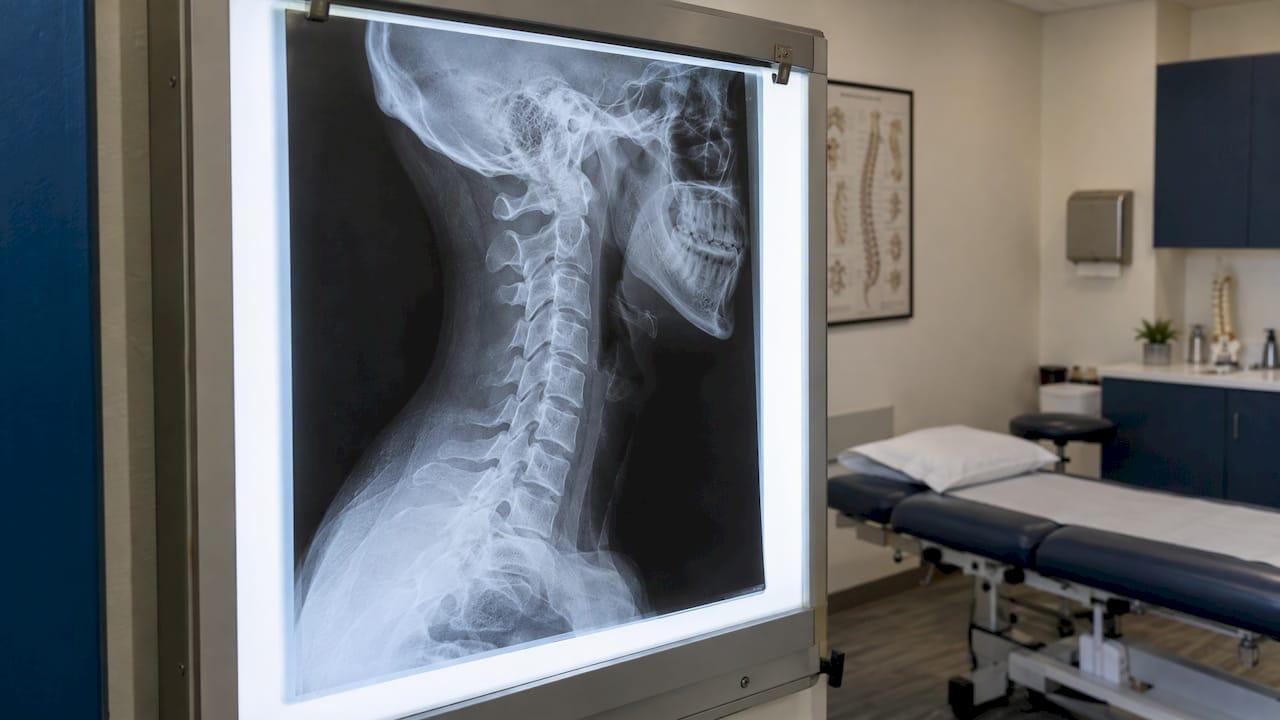
Loss of cervical lordosis means the gentle forward curve of your neck looks flatter, straight or even reversed on an X-ray. It is a finding on an image, not a disease, and it often turns up in people with no symptoms at all. What matters is how your neck moves, how your head sits over your shoulders and what your symptoms are. That is why a careful exam, with measurement and imaging, tells you far more than the words on a radiology report. At Johnson Spinal Care, our NUCCA doctors start there, before any adjustment.
TL;DR
- Cervical lordosis is the neck’s normal inward curve. Loss of it (sometimes called straight neck syndrome) means the curve looks flattened or reversed on a side-view X-ray.
- A straight neck is common, including in people without pain, so the image alone does not explain your symptoms.
- It can go along with stiffness, neck pain and headaches. Causes include injury, long hours in a forward head posture and age-related changes.
- Strengthening exercises, staying active and a thorough exam are the practical starting points.
- Pain that is constant, worse at night, follows trauma or comes with numbness or weakness needs medical evaluation first.
Table of Contents
- What the neck’s curve is and what losing it means
- How common is a straight neck?
- What can cause the neck to lose its curve
- Symptoms people connect to a straight neck
- How a straight neck is found and measured
- What helps: the evidence in plain terms
- Why we look at the top of the neck first
- When to get evaluated promptly
- Our perspective
- Getting checked near you
- FAQ
- Sources
What the neck’s curve is and what losing it means
Your spine has natural curves. In the neck, the cervical spine curves inward, toward the back of the throat. Doctors call this curve lordosis. Think of it as a shock absorber: the curve helps your neck carry a head that weighs about as much as a bowling ball.
When that curve flattens, the neck looks straight from the side. When it bends the other way, the term is cervical kyphosis, sometimes called military neck. Online you will also see straight neck syndrome and reversed cervical curve. They all describe the same kind of finding: the shape of the neck on a lateral (side-view) X-ray.
The finding says something about shape. It does not say, by itself, why you hurt or whether you will. Understanding that difference is the most useful thing you can take from this page.
How common is a straight neck?
More common than most people expect. A 1994 study of neck X-rays found a straight cervical spine in 19% of 83 patients with acute neck pain and 26% of 83 with chronic neck problems. It also showed up in 42% of 80 X-rays from the general population. Women were more likely than men to have a straight neck. The authors concluded the data did not support the idea that a straight neck simply reflects muscle spasm from pain.

A review of cervical curvature variations reaches a similar place: straightening or reversal is commonly seen after trauma, but it can also be a normal variant. And a 2017 narrative review notes that about 20% of the asymptomatic population in an early-1970s study showed straightening or inversion of the curve.
What this means for you: if a radiology report says loss of lordosis, you have not been handed a diagnosis. You have been handed a clue to look into, alongside your symptoms, history and a hands-on exam.
What can cause the neck to lose its curve
There is rarely one cause. The most common contributors are these:
- Injury. Whiplash from a car accident, a sports collision or a fall can change how the neck sits. Straightening is commonly seen after trauma.
- Muscle guarding. After an injury or during a flare-up, muscles can tighten and hold the neck in a flatter position. The 1994 study above suggests this is not the whole story, but it can be part of it for some people.
- Forward head posture. Hours of looking down at a phone or laptop pull the head forward of the shoulders. Our guide to desk neck pain explains how this loads the neck over time.
- Age-related change. Cervical spondylosis, the gradual wear of discs that starts with normal aging, most often affects the C4-C5, C5-C6 and C6-C7 levels. A 2019 evidence-based review says it can lead to arthritic changes and loss of the normal curve, with a deep, dull, throbbing ache, stiffness or headaches.
- Natural variation. Some necks are simply built straighter. Curvature also changes through life: in a radiographic study of more than 2,000 people, neutral-position lordosis increased gradually with age in both healthy and symptomatic groups.
Symptoms people connect to a straight neck
When a flattened curve goes along with symptoms, people typically describe:
- A stiff neck and less range of motion, especially turning or looking up
- A dull, aching pain at the base of the skull or across the shoulders
- Headaches that start in the neck and move toward the forehead or behind the eyes
- Tension that builds through the workday and eases on weekends
- Waking up sore or stiff
Some research links the amount of curve to pain. One study of nearly 300 cervical X-rays, described in the 2017 review, found a statistically significant association between neck pain and a curve below 20 degrees. The authors of that review are also candid that clinicians remain far from definite statements about the finding’s role in symptoms. Both things can be true: the curve matters for some people, and it is only one piece of the picture.
If headaches are your main problem, read how neck pain and migraines connect. If mornings are the hard part, see our page on waking up with neck pain.
How a straight neck is found and measured
The usual tool is a side-view X-ray taken while you sit or stand. A 2022 review in degenerative cervical myelopathy explains that lordosis is assessed by the Cobb angle, drawn from C1 or C2 down to C7, and is best evaluated under load-bearing conditions (sitting or standing) rather than lying down. The same review describes what other imaging adds:
- Flexion-extension X-rays look at stability and how the neck moves when you bend forward and back.
- CT shows bony detail.
- MRI shows the spinal canal, the spinal cord and the discs.
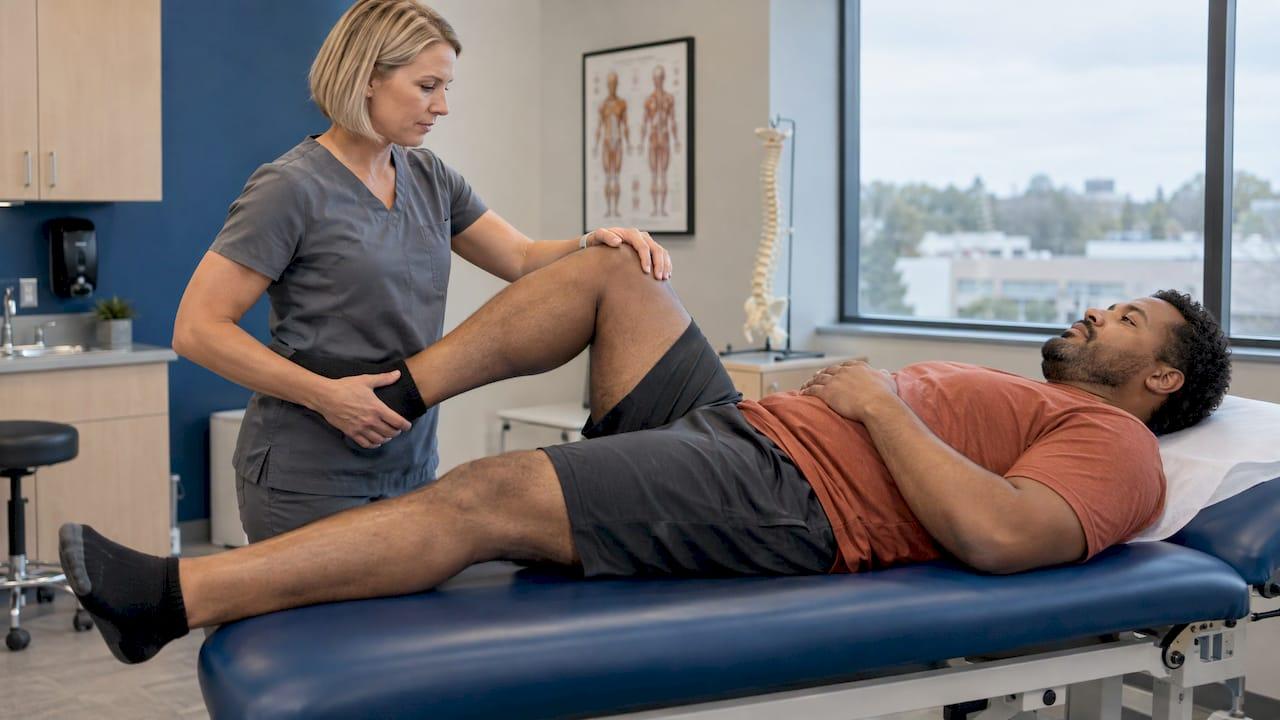
A good exam also looks at things no X-ray can show: how your head sits over your shoulders, how each part of the neck moves, which movements reproduce your symptoms, and your history of injuries. Our overview of chiropractic X-rays explains why and when we image and what to expect in the room.
What helps: the evidence in plain terms
The encouraging news is that most neck pain settles. The 2019 review notes that most acute neck pain resolves within two months. It also says that evidence for any single intervention is limited, which is why the basics matter.
Stay active. The ACOEM cervical and thoracic spine guideline says that returning to normal activity most often helps functional recovery, and that bed rest is not recommended for essentially all neck pain.
Strengthen, don’t just stretch. The same guideline states that strengthening exercises have the best evidence among exercise approaches for neck pain, while non-specific stretching is not recommended. Deep neck flexors and upper back muscles are the usual targets.
Combine approaches. According to the 2019 review, multimodality strategies outperform single-modality ones. Physiotherapy followed by home exercise helps acute neck pain, and the ACOEM guideline reports that manipulation or mobilization combined with exercise shows short-term pain relief and better range of motion in non-specific neck pain. Many people also find that massage for neck pain eases the muscle tension that builds around a stiff neck, which can make exercises easier to do.
Rebuild the curve, where appropriate. A 2021 systematic review of nine controlled trials found that cervical extension traction increased measured lordosis by 12 to 18 degrees over 5 to 15 weeks, with pain and disability improvements maintained up to 1.5 years. These programs take a lot of sessions: 15 to 60 in the trials reviewed. The takeaway is that the neck’s shape is not fixed, and that a sustained, structured plan is what produces lasting change.
Fix your daily setup. Screen height, phone habits, sleep position and your car seat all feed forward head posture. Our pages on neck pain when driving and desk neck pain give specific changes to make.

Why we look at the top of the neck first
The atlas (C1) is the topmost vertebra. It supports the skull and sits where the neck meets the head, so small changes there can affect how the whole neck below it holds itself. NUCCA is an upper cervical chiropractic method built around that region. Our doctors measure and image your neck first, then use a precise, low-force correction. There is no twisting, popping or cracking.
We design our care plans around holding alignment, so patients can need fewer visits over time. If your X-ray shows a flattened curve alongside symptoms like headaches, dizziness or a stiff neck, we examine how your upper neck is positioned and whether it is contributing.
When to get evaluated promptly
Most neck pain is not dangerous, but a few patterns call for a medical evaluation before anything else. The 2019 review lists the red flags that need serious causes ruled out first:
- Pain that is not relieved in any position, or is typically worse at night or at rest
- Neck pain after trauma, such as a car accident or a fall
- Signs of infection or a history of cancer
- Severe neurologic symptoms, such as arm weakness, numbness, trouble walking or loss of coordination
- Age younger than 20 or older than 50 with new, unexplained neck pain
The review recommends MRI for persistent or progressive neurologic symptoms. If you have any of these, see your medical doctor or go to urgent care. If you have severe symptoms such as sudden weakness, trouble speaking or loss of bladder or bowel control, call 911. Once you have been cleared, we are glad to work alongside your medical team.
Our perspective
A report that says loss of lordosis can be alarming to read, especially when you have been in pain for a long time. We want you to hear this clearly: a straight neck on film is a starting point for questions, not a verdict.
In our 40 years of practice, since Dr. Kerry and Lisa Johnson opened the first NUCCA clinic in Minnesota in 1986, our approach has stayed the same. We measure first, we image so that we are working from your actual anatomy, and only then do we make a correction. It is light and precise, with no twisting or cracking of the neck.
Our five NUCCA-certified doctors focus on the upper cervical spine, especially the atlas, because that is where the head and neck meet. We build each plan around holding alignment, so that your body can settle and you need fewer visits over time.
Many people arrive after trying medication, massage or therapy. They are often frustrated, and they are right to want someone who looks for the underlying cause. That is the work we do.
Johnson Spinal Care Clinical Team
Getting checked near you
If you have been told you have a straight neck, or you live with neck pain, headaches, dizziness or stiffness and want to know whether your upper neck plays a part, we can start with a thorough exam and imaging. Our NUCCA upper cervical chiropractic care is gentle enough for patients of all ages, from children and athletes to seniors.

We have three Twin Cities clinics: Apple Valley, Savage (see our neck pain care in Savage) and White Bear Lake in Vadnais Heights. Patients rate us 4.9 stars on Google across 394 reviews.
FAQ
Is loss of cervical lordosis serious?
On its own, usually not. Straight necks appear on X-rays of people without pain, and reviews describe them as possible normal variants. What deserves attention is the combination of the finding with symptoms, a past injury or neurologic signs such as numbness or weakness. In those cases, see your doctor.
Can a straight neck be corrected?
Research shows the curve can change. A 2021 review found that structured extension traction programs increased lordosis by 12 to 18 degrees over several weeks. Posture, strengthening exercise and a plan built around your exam findings all matter. Ask your provider what a realistic goal is for your neck.
Can a straight neck cause headaches?
It can go along with them. The 2019 review describes stiffness and headaches as part of the picture in age-related neck changes. Headaches that start at the base of the skull and spread forward are worth having your upper neck examined. Our page on chronic daily headaches and the neck explains the connection.
Does a NUCCA adjustment hurt or crack?
No. NUCCA uses a light, precise correction with no twisting, popping or cracking of the neck. Care begins with an examination and imaging so the correction is based on your measurements.
Should I see a doctor before a chiropractor?
See a medical doctor first if your pain follows an accident, is constant or worse at night, or comes with numbness, weakness or trouble walking. For ongoing stiffness, headaches or dizziness without those signs, a NUCCA exam is a reasonable next step, and we are happy to coordinate with your medical team.
Sources
- The straight cervical spine: does it indicate muscle spasm? (1994)
- The curve of the cervical spine: variations and significance (1993)
- Loss of cervical lordosis: What is the prognosis? (2017)
- Age-related and degenerative changes in the osseous cervical spine (2016)
- Evidence-based diagnosis and treatment of cervical spine disorders (2019)
- Degenerative cervical myelopathy: a practical approach (2022)
- ACOEM Cervical and Thoracic Spine Disorders guideline (2018)
- Restoring cervical lordosis by cervical extension traction (2021)
- Massage for neck pain