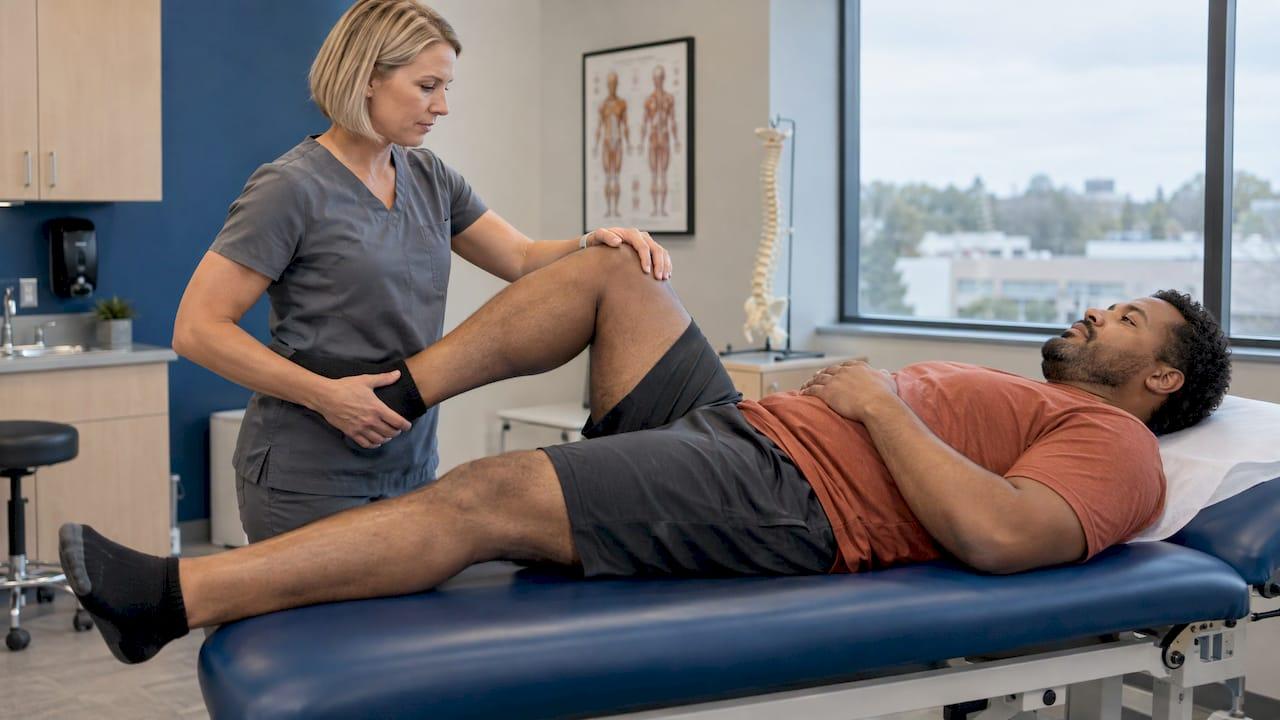

A neck strain is an injury to a muscle or tendon. A neck sprain is an injury to a ligament, the tough band that connects one bone to another. The two feel alike and often happen together, so the useful question is less “which one is it?” and more “is this healing the way it should, and is anything more serious going on?” This guide explains the difference, how long recovery usually takes, which signs mean you need medical care now, and when pain that lingers deserves a closer look at the upper neck.
TL;DR
- A strain involves a muscle or tendon. A sprain involves a ligament. UVA Health describes both as causing pain, stiffness and swelling.
- Even clinicians can find them hard to separate, and they frequently occur at the same time. Treatment is similar either way.
- Many people improve within about 8 weeks. Pain that lasts past 3 months suggests something more than a simple soft-tissue injury.
- Severe pain, weakness, numbness, paralysis or a significant crash or fall means urgent medical care first.
- If neck pain, headaches or dizziness linger after healing should be done, an exam of the upper neck is a reasonable next step.
Table of Contents
- Strain vs. sprain: the core difference
- Why they are so hard to tell apart
- When it is not a strain or sprain: red flags
- How long recovery takes
- What helps in the first weeks
- When pain lingers: look at the upper neck
- Our perspective
- Getting an upper cervical exam
- FAQ
- Sources
Strain vs. sprain: the core difference
Think of the neck as a stack of bones (vertebrae) held together by ligaments and moved by muscles. Muscles attach to bones through tendons.
| Neck strain | Neck sprain | |
|---|---|---|
| Tissue injured | Muscle or tendon | Ligament |
| Typical cause | Overuse, awkward posture, sudden lifting, a sleeping position that overstretches muscles | Trauma, such as whiplash, where the head is thrown forward and back |
| What it feels like | Aching, tightness, muscle spasm, pain that worsens with movement | Sharp or deep pain, stiffness, swelling, a sense that the neck is less stable |
| Often accompanied by | Tender, knotted muscles | Headache, dizziness, jaw pain after whiplash |
UVA Health explains that a sprain is a ligament injury from overuse or trauma, with whiplash as a common example, while a strain is a tendon or muscle injury. The muscles most often strained include the trapezius, levator scapulae and scalenes, and Medscape’s clinical reference names traffic crashes as the leading cause of cervical sprain and strain.
Why they are so hard to tell apart
The same event can stretch a muscle and a ligament in one moment. A rear-end collision, a fall on the ice, a tackle or even a hard sneeze with your head turned can load both tissues. Pain, stiffness and tenderness show up in both, which is why clinicians treat “sprain/strain” as a single working diagnosis in most cases.
A few clues help, though they are not a diagnosis:
- Muscle-type pain tends to be achy and broad, with spasm and tender knots, and it often eases a little as you warm up and move.
- Ligament-type pain tends to be deeper and more specific, worse at the end of a movement, and may come with a feeling of instability or swelling.
- Whiplash patterns can add headaches, dizziness and jaw pain, according to UVA Health.
When it is not a strain or sprain: red flags
By definition, a sprain or strain diagnosis excludes a fracture, so ruling out something more serious comes first. Go to an emergency department or call 911 after a significant impact, or if you have any of these:
- Severe neck pain after trauma
- Tenderness directly over the bones of the spine
- Weakness, numbness or tingling in both arms or legs, or paralysis
- Loss of consciousness or confusion
- A neck that you cannot move, or that you are afraid to move
These match the red flags the American Academy of Family Physicians lists for neck injuries, including bilateral symptoms, focal spine tenderness, paralysis and severe pain. For suspected spinal trauma, CT is generally the first-line imaging in a hospital setting.
If your symptoms are mild, with no trauma and no neurologic signs, imaging in the first month is generally unnecessary. Your primary care doctor can help decide.
How long recovery takes
The timeline is similar for both injuries.
- Most mild cases: Guidelines from the Rhode Island Workers’ Compensation Court’s Medical Advisory Board estimate 1 to 6 weeks of care, with symptoms generally resolving within 6 weeks.
- Many patients: Improve within 8 weeks, though full resolution in that window may not be common.
- After whiplash: Recovery happens mostly in the first 2 to 3 months. Persistent symptoms beyond 3 months lower the likelihood of full recovery, and about half of whiplash patients still have symptoms at one year.
The same StatPearls review lists what predicts a slower recovery: high initial pain, headache at onset, low back pain, older age and a higher whiplash grade. If several of these describe you, an earlier evaluation is sensible rather than waiting it out. For a week-by-week picture after a crash, see our whiplash recovery timeline.
What helps in the first weeks
Current guidance favors staying gently active over bed rest. StatPearls reports that early mobilization and activity are recommended over rest and prolonged collar use once structural injury has been ruled out, and that supervised exercise reduces pain and disability. The RI board lists over-the-counter pain relievers, physical therapy and spinal manipulation, massage or traction among non-operative options, with therapy possible from the day of injury.
Practical steps:
- Keep moving within a comfortable range. Slow turns and gentle tilts are better than holding still.
- Avoid positions that load the neck for long periods: phone-down posture, a monitor set too low, a pillow that props your head sharply. Our guides to desk neck pain and waking up with neck pain cover these in detail.
- Ask your doctor or pharmacist which pain reliever is safe for you, especially if you take other medications or have kidney, stomach or heart conditions.
- Track your symptoms. Note whether headaches, dizziness or jaw pain appear, since that changes what should be examined.
When pain lingers: look at the upper neck
If you are past the 6 to 8 week mark and pain, headaches or dizziness have not settled, a simple muscle or ligament tweak is no longer the whole story. Medscape notes that pain persisting longer than 3 months suggests more significant ligament, disc or facet joint injury. The top of the neck, where the skull rests on the atlas (C1), is rich in the nerves and joint sensors that help control balance and head position. When it is injured in a whiplash or a fall, symptoms often travel beyond the neck, which is why people recovering from a crash often report headaches or dizziness too. You can read more in our pieces on neck pain and migraines, cervicogenic dizziness and chronic daily headaches.

This is where a different kind of exam helps. Many people who reach us have already tried medication, massage or physical therapy and want someone to look for the underlying cause rather than treat the sore spot alone.
Our perspective
We have practiced NUCCA upper cervical care since 1986, when Dr. Kerry and Lisa Johnson opened the first NUCCA clinic in Minnesota. Our five NUCCA-certified doctors see many people whose neck injury was labeled a strain or sprain, treated, and still never fully resolved.
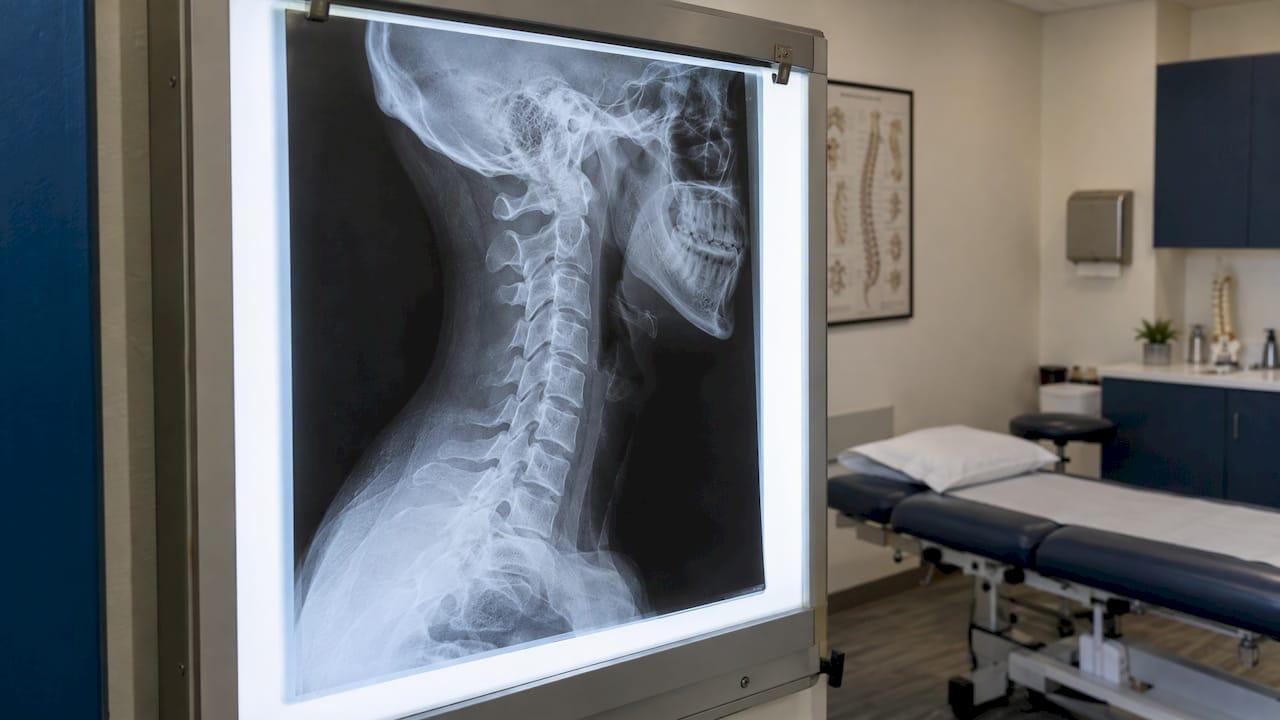
Our approach starts with measurement. Before any correction, we complete a comprehensive examination and advanced imaging of the upper cervical spine, so the plan is built on what we find, not a guess.
The correction itself is precise and low-force. There is no twisting, popping or cracking of the neck. The goal is to hold alignment, so that over time you need fewer visits, not more.
If you are recovering from whiplash, a sports injury or a concussion, we work alongside your medical team, and we encourage you to have any red-flag symptoms evaluated by a physician first.
Johnson Spinal Care Clinical Team
Getting an upper cervical exam
If neck pain, headaches, dizziness or whiplash symptoms are hanging on, our NUCCA upper cervical chiropractic care begins with that detailed examination and imaging, followed by a gentle, individualized plan. We see patients of all ages, from children and athletes to seniors, at clinics in Apple Valley, Savage and White Bear Lake (Vadnais Heights). Our patients rate us 4.9 stars across 394 Google reviews.

You can find your nearest clinic on our locations page, or learn about the Apple Valley clinic and White Bear Lake clinic. If your pain began in a crash, our whiplash care page explains what an exam involves.
FAQ
How do I know if I have a strain or a sprain?
You usually cannot tell on your own, and often both are present. A strain tends to feel achy with muscle spasm, while a sprain tends to feel deeper, stiffer and more swollen after a jolt such as whiplash. What matters more is ruling out red flags and watching your recovery.
What heals faster, a strain or a sprain?
Mild strains often settle faster because muscles have a good blood supply, while ligaments tend to take longer. In practice, guidelines group them together and expect most cases to resolve within about 6 weeks. If you are still hurting after 3 months, get it evaluated.
Should I use ice or heat?
Either can make a sore neck more comfortable, and the evidence for one over the other is limited. Use whichever feels better in short sessions, keep gently moving, and stop if your skin becomes irritated.
Can a chiropractor help with a neck sprain or strain?
Manual therapy is among the options named in current guidance alongside supervised exercise. At our clinics, NUCCA care starts with an exam and imaging, and the correction is gentle with no twisting or cracking. If you had a serious trauma, see a physician first.
Sources
- Neck Sprains & Strains, UVA Health
- Cervical Sprain and Strain, Medscape
- Cervical Sprain, StatPearls, NCBI Bookshelf
- Management of Head and Neck Injuries by the Sideline Physician, American Family Physician, 2022
- Cervical Musculoligamentous Injury (Sprain, Strain), Rhode Island Workers’ Compensation Court Medical Advisory Board, 2019